

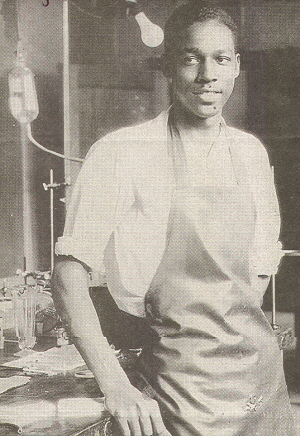
About Vivien Thomas
Published
This Black History Month we're celebrating Black pioneers who changed children's surgery. First up is Vivien Thomas (1910 to 1985), a surgical technician at Johns Hopkins in the USA.
With no medical degree, and hired on a janitor's grade, he perfected the first surgical treatment for Tetralogy of Fallot, and coached Alfred Blalock through the first operation in 1944. The shunt is now known as the Blalock-Thomas-Taussig shunt.
The start
He dreamed of being a doctor, but the Great Depression wiped out his college savings. In 1930 he became lab assistant to surgeon Alfred Blalock. He never went to medical school. At Vanderbilt he was paid as a janitor, despite doing a surgeon's research.
The breakthrough
Taussig asked whether more blood could reach the lungs, and Thomas perfected a subclavian-to-pulmonary artery shunt in the lab. In November 1944, from a step stool, he coached Blalock through the first one.
The legacy
He was left off the 1945 paper, but was given an honorary doctorate by Hopkins in 1976. The operation reached Guy's Hospital, London, in 1947.
This looks like something the Lord made.
References
- PBS American Experience (WGBH). Partners of the Heart. Available from: https://www.pbs.org/wgbh/americanexperience/films/partners/
- Vanderbilt University Medical Center. Vivien Thomas (1910 to 1985). Available from: https://www.vumc.org/main/person/vivien-thomas-1910-1985
- Treasure T. Journal of the Royal Society of Medicine. 2017;110(9):376-9.